

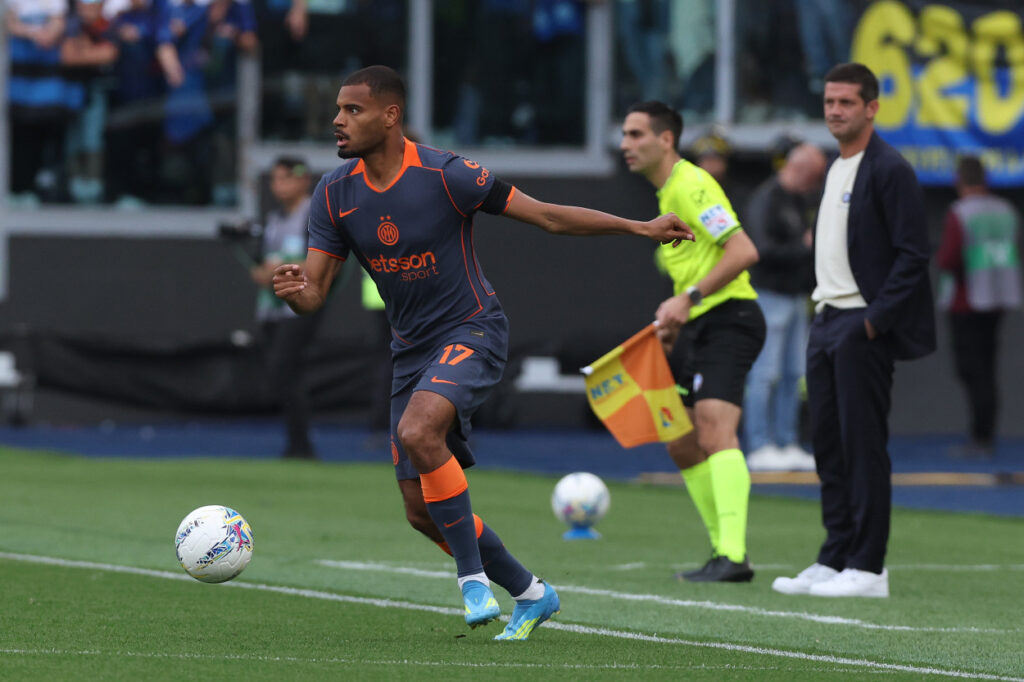
The statements made by Andy Diouf about his position on the field have not gone unnoticed in France. The Inter midfielder had said: “Even at Inter I play in a position that isn’t mine, but the important thing is to help the team.” Words that sparked criticism, particularly from journalist Florent Gautreau during the ‘After Foot’ podcast on RMC Sport.
“I didn’t really like his comment at the end of the match,” declared Gautreau. “He said that, in fact, even at Inter he doesn’t play in his role and you can sense that he’s disappointed not to play in his position. He insisted a lot on this, saying he prefers to play elsewhere. I found it curious that, when you’re called up to the French national team, where you’re currently being asked to play in a position more similar to the one you have at Inter, you act a bit picky and have this kind of attitude.”
The journalist pointed out how Diouf’s role at the Nerazzurri club does not correspond to the scheme of the French national team. “What I mean is that I found what he said a bit out of place. I would understand more if, at a club, you fought over time to find the role you prefer. But if you arrive in the national team, in quotation marks, miraculously, because the coach has changed and wants to see new faces, I don’t think this is the first thing you should say.”
According to Gautreau, the right approach would be different. “In that case you think: ‘I’ll do what I’m asked’, because he doesn’t care, he can put you on the left or as a left-back, I don’t know. Besides, I don’t yet know enough about Zidane’s way of working. Maybe he can forgive him, maybe they can talk about it.”
The discussion broadened to a wider issue regarding French midfielders. “There’s a real issue with midfielders being moved back or shifted in position. Camavinga, Zaïre-Emery, even Tchouaméni, when he played as a central defender with Real Madrid: every time they speak, the concept is: ‘Yes, yes, I adapt, but I want to play in midfield’,” explained the journalist.
“It’s something that is often expressed in a rather aggressive way, as if they see this move as a step back, as a rejection, while the players we mentioned are often very good precisely in those roles,” added Gautreau. “But above all, I insist on the young age of the boy. He’s lucky to be called up, to be involved in a new adventure. I would focus everything on communication, saying: ‘No problem, he can play me wherever he wants, I’ll play.’ In short, the classic attitude. The one where you say: ‘If you make me play as a goalkeeper, I’ll come and play as a goalkeeper.’ On the other hand, if your name is Dembélé or Olise, yes, maybe you can say: ‘Sometimes it’s true, I prefer to play here or there.’”
 CONTINUE READING