

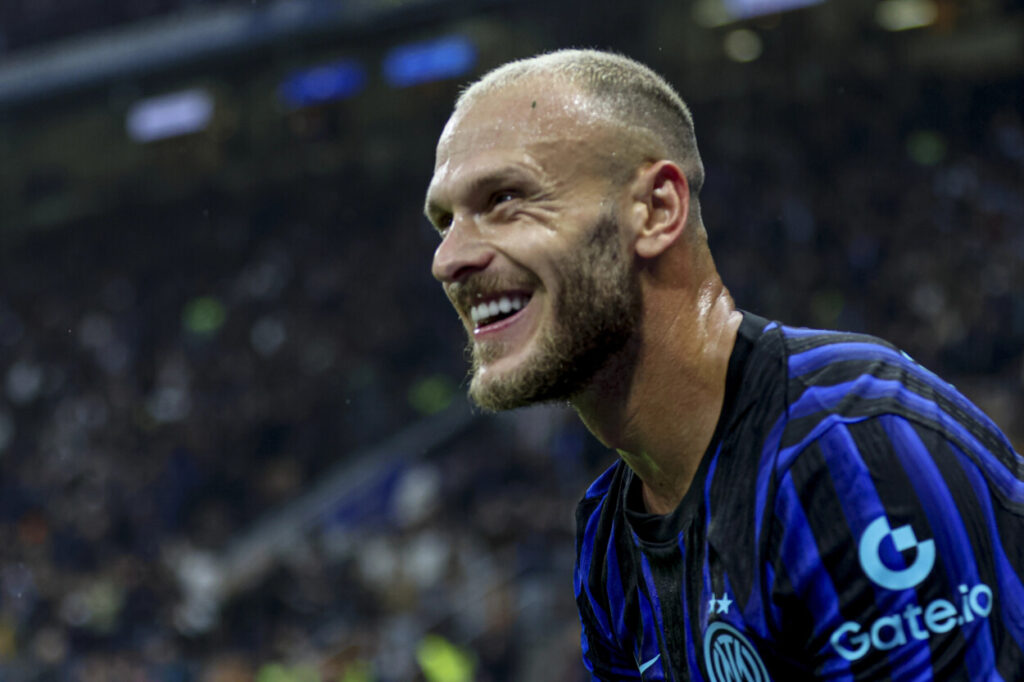
The Perth derby ended 1-1, with Inter showing encouraging signs despite the final result. Dimarco broke the deadlock, then a questionable penalty awarded to Milan allowed Christopher Nkunku to equalize in the 84th minute. The team legitimized their lead with a good end to the first half and an excellent start to the second, before the penalty episode changed the momentum.
Yann Bisseck was deployed again at the center of defense due to a lack of alternatives and confirmed with his actions what he had stated in recent days: the position doesn’t matter, what counts is being able to contribute. After escaping the risk of an ankle injury in the seventh minute, he returned to the field, patching up several defensive gaps and sacrificing himself with a yellow card on Chukwueze. Tactically valuable, he allowed the team to gain ground by keeping the defensive line high and easily controlling Camarda. He was attentive in tracking back even after the more dangerous Rafa Leao came on, but had to leave the field injured right at the end.
Nicolò Barella is not in top athletic condition, which is only to be expected. At the start, he struggled with the crowded midfield, where the Rossoneri closed down spaces and pressed intelligently. As the minutes passed, he began to get into his rhythm, trying to spark dangerous moves in the opponent’s half and consistently linking up with Andy Diouf on the right center. Beyond the perfect assist for Federico Dimarco, his fighting spirit deserves praise: the derby is always the derby.
Piotr Zielinski had a somewhat difficult first half, with limited space and little movement around him. However, with his feints he always seemed to know the best play to make at any given moment. In the second half, as a playmaker, he took charge and started moving the ball with fluidity and quality, playing precise vertical passes and maintaining possession without hesitation.
Like many teammates, Dimarco struggled in the early stages, because Milan allowed little depth and Chukwueze seemed to be having a good day, to the point that pushing too far forward would not have been advisable. When Inter started to gain ground, the winger found his comfort zone and in the first fifteen minutes of the second half he was a key factor, with constant runs, timely crosses, and the goal that gave them the lead with an excellent run. Aerobically strong, he stayed on the pitch for over 80 minutes.
Pio Esposito showed some progress compared to his anonymous performance against Manchester City, although alongside the inexperienced Iddrissou, as the offensive reference point and with a team that for much of the first half pushed forward little, life was complicated. The Rossoneri center-backs didn’t hold back: even receiving the ball and turning became almost an achievement. His dedication was the usual – if there’s a physical battle, he never backs down – but offensively there was little to see, apart from a shot at the end of the first half. He needs more time to find his best physical form.
Jamal Iddrissou, 18 years old, experienced one of his first real matches with the adults. Against Matteo Gabbia and Stahinja Pavlovic, it would be tough for anyone to shine, and inevitably his performance suffered. He was not very present, and aside from pressing and obvious effort, he struggled to produce noteworthy plays. Even difficult performances like this can only help him in his growth path.
 CONTINUE READING