

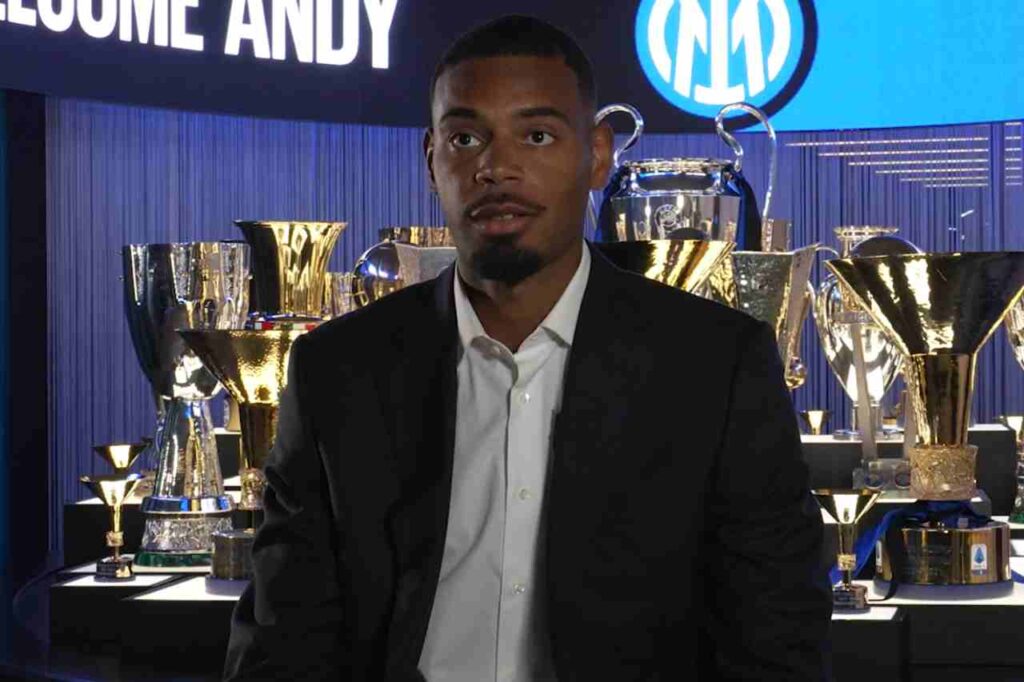
The illusion of having found the solution on the right wing dissolved against Manchester City. The brace in injury time against Karlsruhe had fueled the enthusiasm around Diouf, turning what Chivu had called a “crazy idea” into a possible certainty for the right wing-back role.
After the two goals scored in the final minutes against the Germans, many were convinced that the player could really be the surprise in that position. However, the performance against the English side brought everyone back to reality: it’s one thing to see Diouf running up and down the wing against a second division German team, it’s another to see him carry out both the offensive and defensive duties required by the role.
The brace after the ninetieth minute had influenced the judgment of the match against Karlsruhe, but without that final exploit, the performance probably wouldn’t have caused such a stir. The wing-back, in fact, must know how to attack but also track back, defend, and become an additional full-back. This is precisely what Diouf was unable to do against Manchester City.
The opponents attacked down his flank regularly and with excessive ease, even though it’s not the player’s fault: defending is not part of his skill set. Thus, the need has resurfaced in all its clarity. Even Chivu admitted it bluntly at the end of the match: “We need it, you can see it too.” An indirect message to the club, with whom, beyond public press conferences, he has probably already discussed this need several times.
It’s no coincidence that the profiles had already been identified: first Palestra, then Khalaili, finally Spence, but for various reasons all negotiations fell through. In the meantime, management has strengthened other departments, starting with the defense, which was left without De Vrij and Acerbi. Stones arrived on a free transfer, a great move, while negotiations are ongoing for Romero, who would be another quality addition.
Currently, the backline can count on Bastoni, Bisseck, Akanji, Stones himself, Carlos Augusto and, if needed, even Pavard, who could stay if necessary. Making a list of priorities, wouldn’t it be more logical to focus the main budget where the greatest urgency lies, namely the right wing, rather than in defense where, at least numerically, Inter is covered?
Not having the budgets of the Premier League, as the negotiations for Spence show, it would be wise to first cover the most obvious gaps: the wings — plural, because even Chivu said that on the left, apart from Dimarco, Carlos Augusto could be adapted, but he prefers him further back — rather than defense or midfield. The hope is that the next investment will be made right there, and then later adjust the other departments that need to be completed. But only after covering the most obvious shortcomings, which at this point seem clear to everyone.
 CONTINUE READING
