

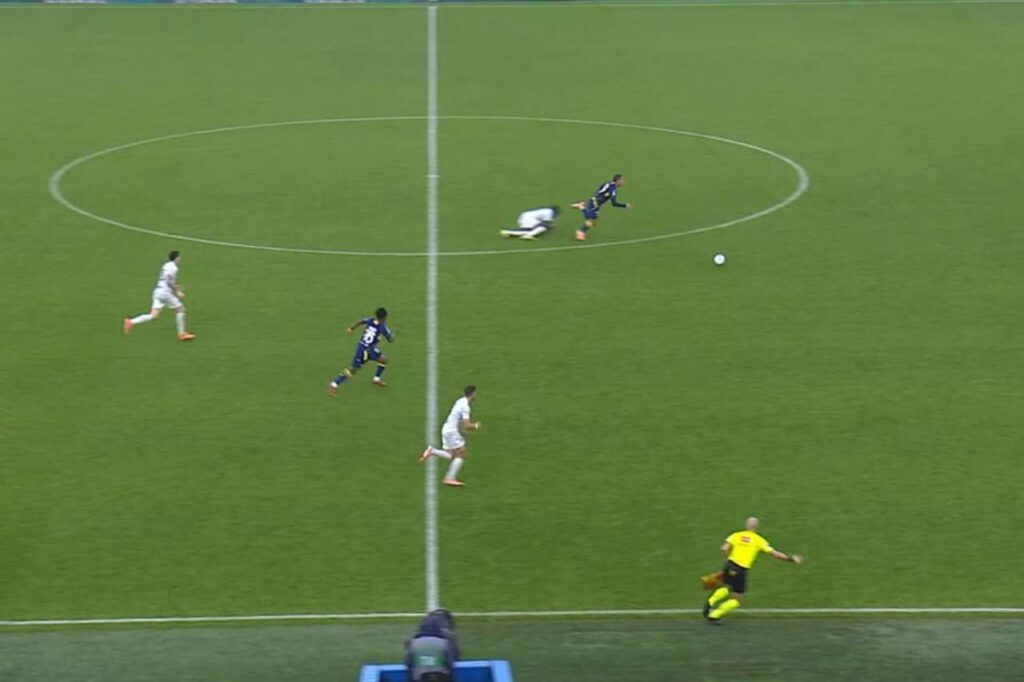
The match this afternoon, won by Inter away at Verona by a narrow margin with a decisive own goal by Frese at the end, ended with some controversy. In particular, the home team protested over an incident that occurred in the 67th minute of the second half: after a very risky back pass by Sucic, Yann Bisseck, as the last man with a lot of open field behind him, was forced to bring down Giovane with a sliding tackle.
Despite the request for a straight red card from the Verona players, referee Doveri showed a yellow card to the German center-back. This decision was also shared by former referee Luca Marelli who, in the post-match analysis of Verona-Inter on Dazn, explained the decision by also citing what is provided for in the rules regarding last-man fouls.
These were his words: “The principle on which to base the analysis of this incident is that it must be seen in motion. In the sense that still images at the moment of Bisseck’s foul could be misleading. Why? Because obviously at the moment of contact between Bisseck and Giovane, the ball is very close to Giovane, but you have to see it in motion, because you need to see where the ball ends up. There is a counterattack that starts from a mistake by Sucic. Giovane gets ahead of Bisseck, you need to see in motion where the ball is going. Let’s remember that one of the parameters on which to base DOGSO is the general direction of the play. As we saw, the ball moves quickly, also because the ground is wet and it’s raining heavily, to the right side of the pitch, therefore not towards the goal. The ball rolls far from the center of the field, in an area where Sucic was already recovering because he realized his mistake. Therefore, one parameter is definitely missing, which is the general direction of the play, and probably a second parameter is also missing, that is, the position of the defenders, because Sucic was indeed recovering. If the ball touched by Giovane had continued straight towards the goal, then in that case we would have had a clear DOGSO.”
