

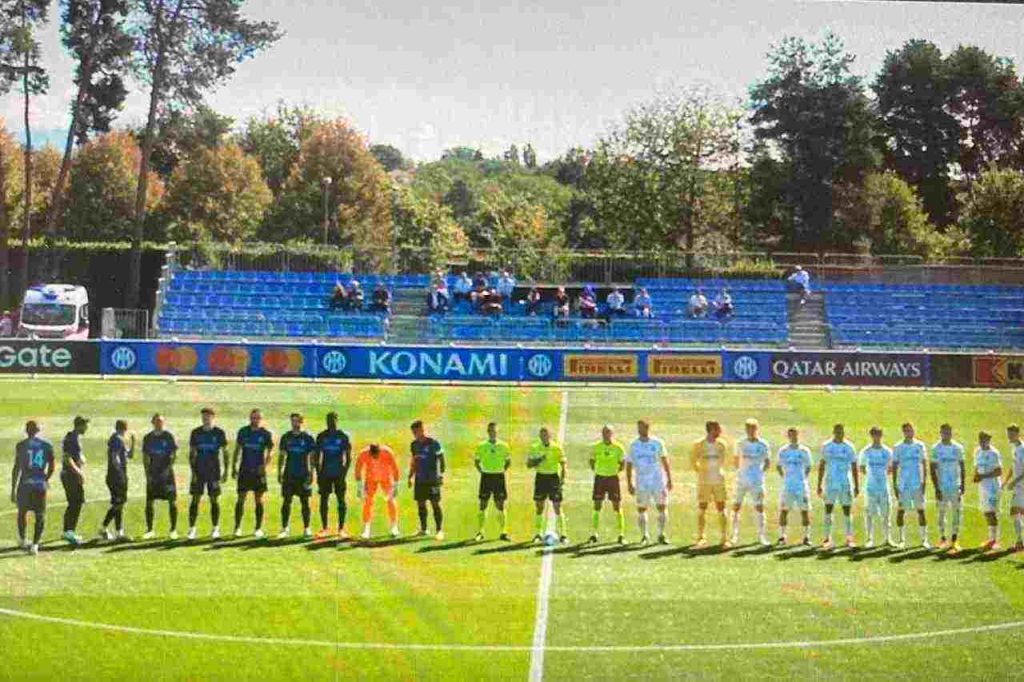
After years of reflection, Inter has officially launched its own Under 23 team in professional football. The Nerazzurri club thus enters a new chapter in its sporting history, inaugurating its participation in the Serie C championship with an ambitious, structured project with enormous potential. An initiative that goes beyond simply registering for a league: it is a long-term vision aimed at bridging the gap between the youth sector and the first team.
Why Inter chose the U23 path
The transition from Primavera to Serie A is one of the most critical in a footballer’s development. The pace, the intensity, the media pressure: everything changes. That’s why the establishment of a second professional team represents a pragmatic response to a systemic problem. The model had already been adopted by Juventus and Atalanta, but Inter preferred to wait for the right moment, to structure a project with solid foundations.
The club identified the Brianteo in Monza as the ideal stadium: a facility already tested for professionalism, with adequate technical spaces and an environment capable of shaping players even from a mental point of view. On the bench will sit Stefano Vecchi, a coach with a highly respectable pedigree between youth sectors and professional categories. He knows the Nerazzurri environment like the back of his hand, but above all he knows how to help young players grow without burning them out.
A tactical laboratory for the future
Inter U23 will not be a simple parking lot for surplus players or youngsters to be evaluated. It is conceived as a real tactical laboratory where modules, roles, and mechanisms similar to those of the first team are tested. Vecchi will work in close synergy with Simone Inzaghi’s technical staff, following consistent guidelines to prepare talents for the big leap.
This type of setup requires a deep knowledge of the game, but also the ability to read between the lines of performances. It’s not enough to see who scores or who runs the most; analytical tools, detailed video study, biomechanical knowledge, and even a pinch of intuition are needed.
And it’s no coincidence that, in parallel, analytical tools are also increasing outside the clubs. In contexts such as non-AAMS sites, for example, predictive algorithms and advanced statistical models are increasingly used to read the trends of minor competitions, including those of Serie C. These platforms are increasingly attentive to the quality of information and technical innovation compared to operators with a national license, reflecting an evolution of modern football, where every piece of data can turn into a concrete competitive advantage.
Objectives: growth, sustainability, and identity
The primary objective is clear: to increase the productivity of the youth sector. Today, producing a talent ready for the first team means saving tens of millions on the market, and guaranteeing technical continuity that is hard to replicate by buying elsewhere. But there is also a question of identity: to train players “the Inter way,” accustomed from the outset to a certain type of pressure, responsibility, and football culture.
The path will not be without obstacles since Serie C is a tough league, where physicality is often favored over aesthetics. The young Nerazzurri will have to learn to play dirty, to defend the result, and manage moments. And for this reason, the work will be gradual. Inter will not immediately demand promotions or titles, but constant growth, technical development, mental development, and above all continuous integration with the first team.
A signal for the whole movement
Inter’s entry into Serie C with its U23 also represents a political signal. It is an endorsement of the second teams project, still viewed with skepticism by many today. However, the benefits are clear to everyone: players do not end up lost in unproductive loans, clubs maintain control over the development of their talents, and the technical level of the third division rises.
It should be remembered that, in the 2024-25 season, Juventus Next Gen brought more than one player to the first team and Atalanta did the same. Now it’s up to Inter to prove that, with the right means, even a prestigious club can invest in the medium-long term without sacrificing immediate competitiveness.
Conclusion: the future is built today
The birth of Inter U23 is not just a technical or administrative operation: it is an act of vision. In an era in which football is becoming faster, more globalized, and more complex, creating an intermediate platform between the youth teams and Serie A is a courageous and far-sighted choice.
For fans, it will be an opportunity to closely follow the new talents, perhaps discovering the next Bastoni or Barella. For the club, it is a tool to remain competitive without having to chase the transfer market every summer. And for the entire Italian football system, a possible model to replicate.
