

Here is the English translation of your text:
—
Before shifting focus to the next match on the calendar, which will see Inter play the second leg of the Coppa Italia semifinal against Milan, let’s close the disappointing Bologna chapter with an analysis of what emerged from the match at the Dall’Ara. Here, then, is our in-depth review, where we dig into some aspects of the game that probably weren’t noticed in Bologna-Inter [HERE THE HIGHLIGHTS OF BOLOGNA-INTER]https://www.passioneinter.com/inter-news/highlights-bologna-inter-20-aprile-2025/.
1 Bologna’s defeat hurts Inter. Not just because of the result, but for what it brings with it: nervousness, controversy, injuries, and suspensions. But above all, credit must be given to an opponent experiencing an extraordinary season. Bologna is a real team, fully in the fight for the Champions League, unbeaten at home for months except for one slip – against Verona – while a man down. Everyone has struggled here: Napoli had a close call, Inter lost. This, more than any other statistic, tells of the intensity that Vincenzo Italiano has given his players.
2 But there are issues that have now become recurring for the Nerazzurri. Above all: game management in the closing stages. Inter have lost a total of 5 points in the final 30 minutes of matches. That’s a significant amount, especially for a team that aspires to dominate in Italy and Europe, and which, with the depth of its squad, should be making the difference in the final periods.
3 From here, inevitably, the discussion turns once again to substitutions. It’s a constant issue. But more than a matter of quality, it’s become a mental issue. The impact of those coming on as substitutes isn’t there, and often it’s even negative. An example? Bisseck, once again thrown into the fray at the end and once again clearly in difficulty. He seems to go into meltdown, lost. Yet he keeps being used. The goal conceded by Bologna is also a result of this: as analyzed by Barella after the game, by Inzaghi in the post-match, and by pundits like Bergomi and Costacurta, a collective responsibility has emerged. More than Dimarco on Orsolini, it’s the overall defensive line’s failure to clear the ball that leaves one perplexed.
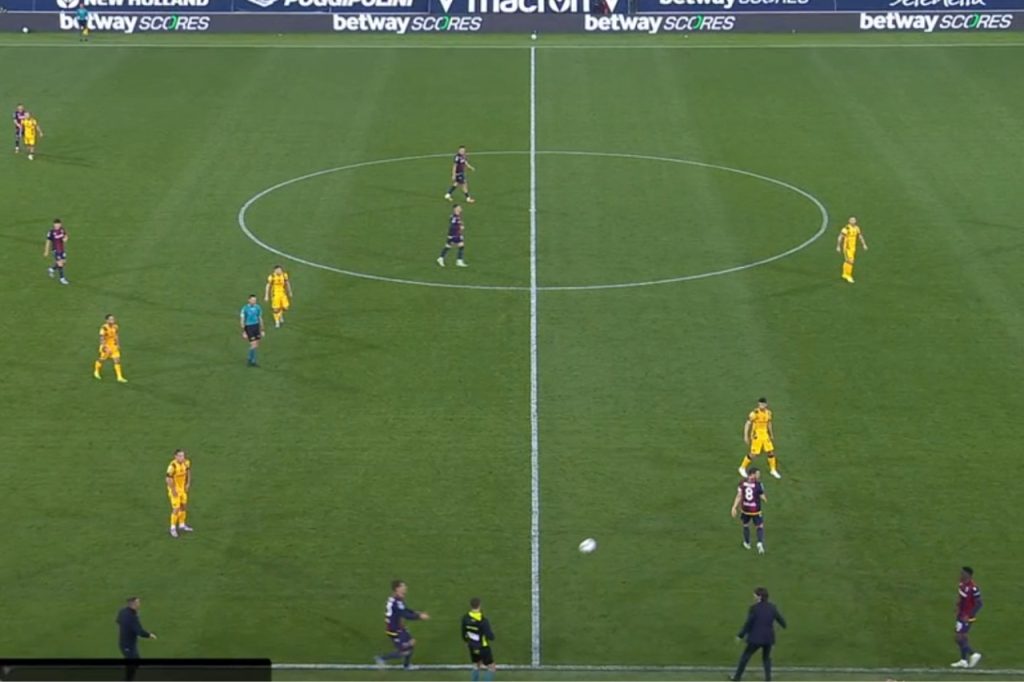
4 Then, of course, there are the refereeing controversies. The symbolic incident? The throw-in from which Bologna’s goal was born, taken at least 10-15 meters ahead of the correct spot. The rules are clear: it should be retaken or a throw-in awarded to the other team. In Monza-Napoli, Castrovilli took one four meters ahead and the throw-in was reversed. Why not here? Colombo failed to convince with his overall management: Bologna is the third highest team for fouls in Serie A, Inter among the lowest, and yet at the Dall’Ara the tally was 21 fouls called against Inter and 12 against Bologna. It felt like home-field management. This does not erase Inter’s mistakes, but it makes a debate about the refereeing legitimate.
5 The match risks leaving heavy aftereffects. Beyond the injuries, there are also two suspensions for the upcoming match against Roma. And on the horizon is a derby which, aside from the standings, becomes almost a must-not-lose match, especially from an emotional and environmental perspective. Many are talking about ‘abandoning the cups’, but with such an intense season, even just managing it becomes a challenge.
6 The regret grows when thinking of what Marotta said in recent days: “This is the most important match of the year.” It became that also—and above all—because of the points dropped elsewhere, such as at Parma, where a much less acceptable slip occurred.
—
