

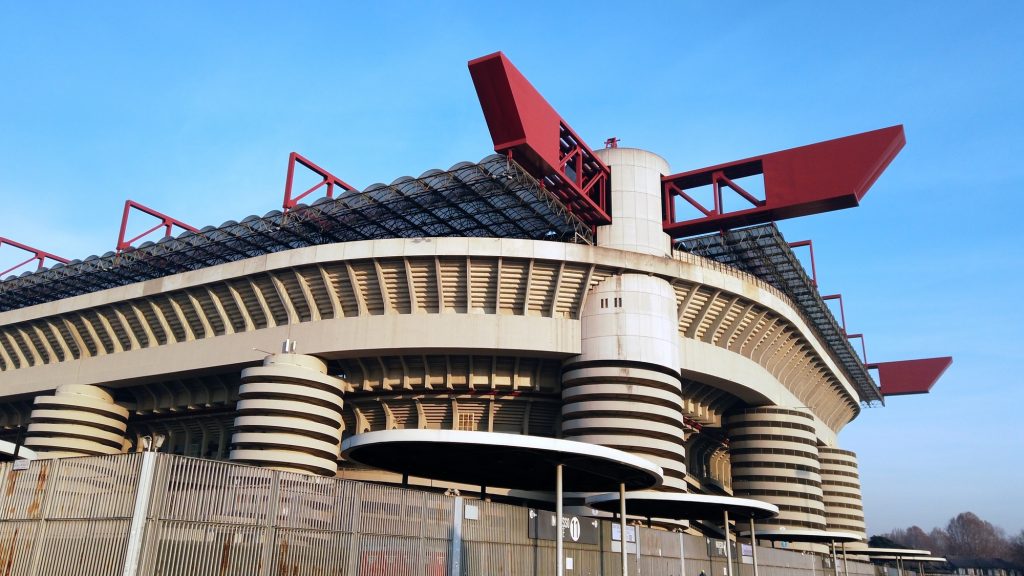
While waiting for Inter and Milan to deliver the highly anticipated document Docfap to the Municipality of Milan for the acquisition of San Siro, surrounding areas, and construction rights, an inevitable question arises: what will become of the Meazza?
The idea of the two clubs is to build a new stadium in the area currently used as parking, without completely demolishing the ‘old’ structure. As reported in an in-depth article published this morning by La Gazzetta dello Sport, the plan for constructing the new San Siro involves demolishing around 75-80% of the existing structure—a necessary sacrifice, although one that feels almost sacrilegious. Thus, it becomes crucial to understand how the demolition will proceed, primarily in terms of time and costs.
One immediate fact stands out above all: the demolition of the stadium alone is expected to cost approximately 80 million euros. Tearing it down comes at a price, not only economic. To better understand the process, La Gazzetta dello Sport drew a comparison with the project undertaken in Bergamo, where the Gewiss stadium formerly Atleti Azzurri d’Italia has undergone partial reconstruction. The newspaper consulted the opinion of Roberto Spagnolo, who was responsible for managing the renovation project for Atalanta’s facility. In that case too, parts of the structure were demolished, though to a smaller extent compared to plans for San Siro; the methodology, however, remains quite similar.
No explosives will be used: “Specialized machinery will be employed. Demolition begins with the removal of non-concrete elements, such as glass, barriers, and doors, a phase known as ‘strip out.’ Next, large mechanical pincers dismantle the structure. Finally, the rubble is crushed, separating concrete from iron.” For many fans, this will mean saying goodbye to a place filled with memories.
Compared to Bergamo, there is at least one advantage: the San Siro area offers more room for manoeuvring. Demolition will start from the roof and proceed downward: first the third ring, then the second, finally the first. According to Spagnolo’s estimate, the operation could take between two and four months—inevitably longer than the 15 days it took to partially demolish the Bergamo stadium, due to the greater complexity involved. Furthermore, part of the existing structure will be preserved: the southeast corner of the stadium, including part of the orange stand and the Curva Sud, will remain to host events, as well as commercial and museum spaces.
All of this might seem straightforward, but it’s not. San Siro dates back to the 1920s, requiring meticulous analysis regarding the materials to be disposed of: “At that time, materials containing substances such as chromium and sulfates were common, which must be appropriately treated at specialized landfills. Asbestos might also be found in some roof structures.” Handling the debris is no minor detail, either in terms of logistics or cost. Concrete will be crushed and transported, but finding available landfills presents another challenge.
